Formula E
THE NEVER SATISFIED
A 60-second film that argues Formula E's soul was never missing — just misremembered. Electric didn't arrive to catch up with petrol. Electric was first. In 1899, an electric car was the first vehicle on Earth to break 100 km/h — and then petrol interrupted, for a century. Gen 4 doesn't reinvent the lineage. It resumes it. This is the spot, and the beginning of a longer film about where electric racing actually comes from.
Formula E haven't commissioned this, yet. We sent it to them because the idea wouldn't leave us alone.
Images made by Google AI Studio.
The short story
What it is. An unsolicited TVC60 for the launch of Formula E's Gen 4 car. Image-led, no dialogue — fifty-four real horses at full gallop on the Bonneville Salt Flats, then a Gen 4 car breaking from the pack at 335 km/h. Two title cards, no voiceover, no CGI, No AI.
The idea underneath it. Electric was first. On 29 April 1899, Camille Jenatzy drove La Jamais Contente — "The Never Contented" — electrically powered car past 100 km/h outside Paris. The first EV on Earth to do so. Petrol didn't beat electric racing; it interrupted it, for roughly one hundred years. Gen 4 is the resumption, not the reinvention.
Why the horses. A horse at full gallop peaks at around fifteen horsepower. Gen 4 runs at roughly eight hundred. Eight hundred divided by fifteen is fifty-four — so the film puts fifty-four galloping horses and one Gen 4 car on the same white ground, and lets the car out-run the herd. The maths never appears on screen. The audience just feels it.
The bigger swing. Our TVC60 is the headline, but behind it sits a 6–7 minute documentary — the real history, told properly: a Belgian engineer, a forgotten land-speed record, a century-long detour through petrol, and a fact almost nobody knows — that endurance racing itself was born on a horse track. The world's first 24-hour motor race ran in 1905 at Driving Park, Columbus, Ohio, on ground originally built for horses. The horses in the film aren't just a metaphor for horsepower. They're where the whole sport began. The advert is the argument. The film is the evidence.
The full story
The title
La Jamais Contente translates two ways. Literally, "The Never Contented." We chose the freer reading — The Never Satisfied — because it carries forward, where "Contented" sits still. It's the name of the 1899 car, and it's the mindset of the whole sport: the relentless dissatisfaction with what is. The soul of Formula E wasn't missing. It was named in French, by an electric car, over a century ago.
The film, shot for shot
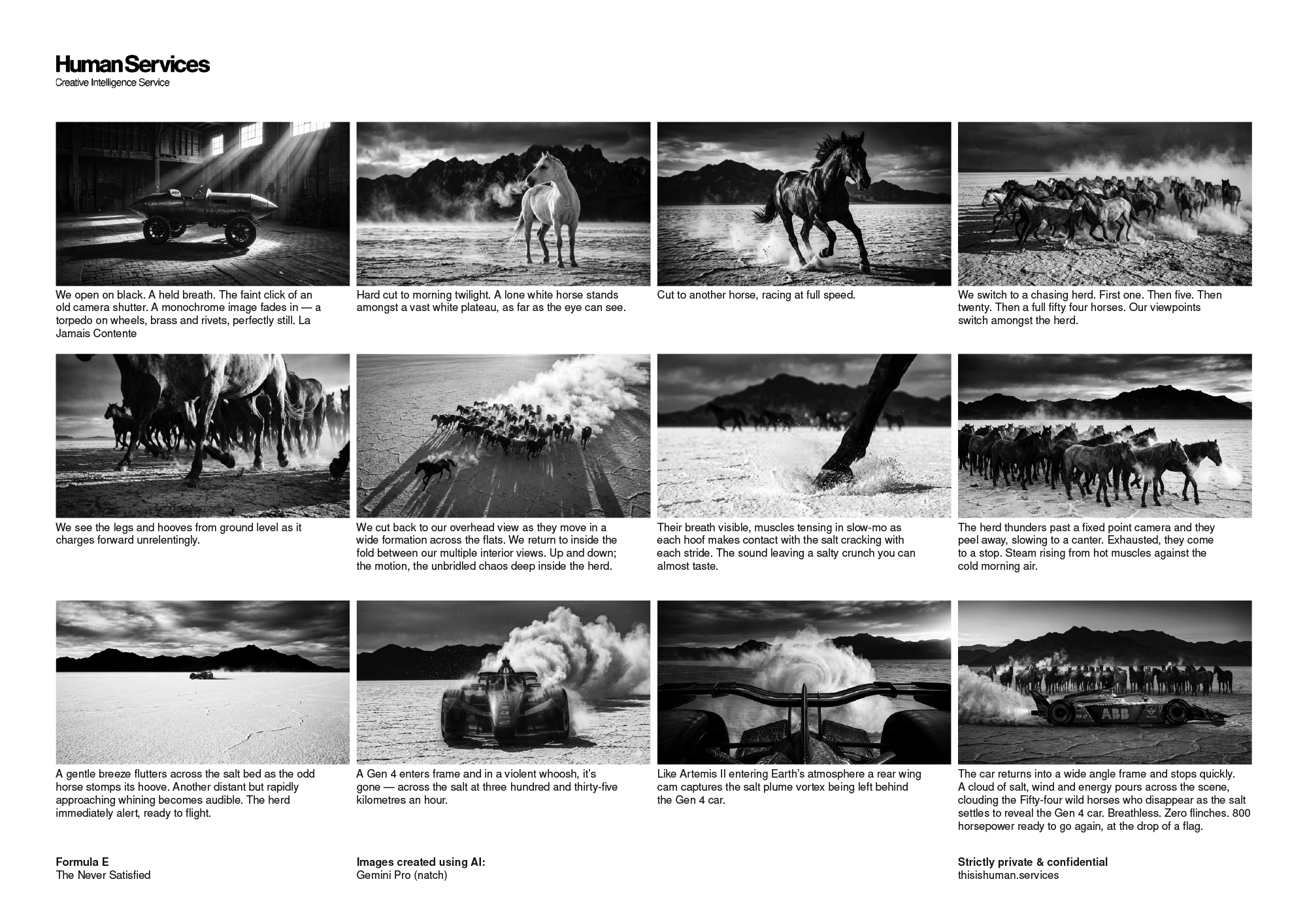
We open on black. The click of an old camera shutter. A monochrome image fades in — a torpedo on wheels, brass and rivets, perfectly still. La Jamais Contente. The original. A line of text: the first human to break 100 km/h did so… in an electric car.
Hard cut to morning twilight on a vast white plateau. A lone white horse. Then five. Then twenty. Then fifty-four — a herd at full gallop across the salt, breath visible, hooves cracking the surface. A second line, held just long enough: Watt determined one horsepower is the work of one horse. Ours has 800.
The herd slows, steams, settles. Then a distant whine — not an engine, not exhaust, a sustained electric note like a held breath. A Gen 4 enters frame and is gone: 335 km/h across the salt. The horses turn, rear, unsettled. The car circles back, stops, and a cloud of salt swallows the frame — clearing to reveal the Gen 4 car where fifty-four horses stood. Breathless. Zero flinches. 800 horsepower, ready to go again.
Why Bonneville
The Bonneville Salt Flats are where humans have measured themselves against speed for over a century — every land-speed record that mattered, from 1914 on. White ground, white horizon, a blank canvas where nothing competes with the car or the horses. It places Gen 4 in the lineage of Bluebird, Spirit of America, Thrust SSC — without saying so. The audience completes the sentence. (Camargue and Salar de Uyuni are the elegant and the epic alternatives, if the logistics demand.)
No fakery
The whole argument collapses if any element in it is fabricated. Real horses. Real salt. Real car. No CGI, no AI, no effects beyond grade and sound design. A film about the difference between the real thing and the imitation cannot itself be an imitation. That's the point — and it's the same point the whole studio is built on.
The documentary
Where the 60 is image-only and pure cinema, the longer film is allowed the evidence: real interviews, archive footage from 1899 onward, location photography, the full timeline told properly — the 1899 record, the century of petrol, the first 24-hour race run on a converted horse track in Columbus, Ohio in 1905, and Gen 4 as the resumption. Its job is to make the 60 feel inevitable. By the end, the viewer should think: of course Formula E ended up here. There was nowhere else to go.
What it points to
When we spoke to Formula E they posed the question they were wrestling with — what is our sport's soul? — this was one answer. Delivered by post, in one of our special red envelopes. Electric was first. Petrol interrupted. The soul was never missing. This is the kind of thinking we do before anyone hires us to.
An unsolicited concept by Human Services.
Not commissioned or endorsed by Formula E, yet.